Craft Funny Animal Characters for Truly Hilarious Stories
Why animal characters are perfect for comedy (and how to avoid the obvious jokes)
Think about your favorite funny stories or cartoons. Chances are, many of them have animal characters that make you laugh.

There’s a special kind of magic when animals act like people, and it’s a secret weapon for writers who want to create truly hilarious stories.
One big reason animal characters are so good for comedy is the surprise factor. When you see a serious [beauceron dog] trying to do taxes, or a fluffy [westie dog] giving life advice, it’s immediately funny. Our brains aren’t expecting it! We naturally give human feelings and actions to animals, a process called anthropomorphism. This helps us understand and connect with them in stories, making the humor land even better, as research shows people often attribute human traits to animals and other nonhuman things to understand them better The Development of Anthropomorphism in Interaction – Frontiers. An unexpected detail, like a [funny duck] wearing a tiny hat, can create an instant giggle because it breaks what we expect from a normal duck.
What’s more, animal characters let writers talk about human problems and silly habits in a way that feels safer and sharper. It’s easier to make fun of someone’s bad temper when it’s a grumpy [canaan dog] rather than a grumpy neighbor. This distance allows for clever satire. A writer can have a dignified [saluki dog] accidentally spill coffee on itself and it’s funny, but if it were a person, the joke might feel too mean. By using animals, authors can show us our own flaws without being too direct, which often makes the humor hit harder and last longer.
If you enjoy reading about funny animal friends and clever stories, you might want to check out some more great tales. Looking for Humorous Fiction? The Ridiculous brings absurd comedy into a full sci-fi story world.

Discovering why certain things make us laugh is part of the fun, and animal characters are definitely a big part of that. Learn more about funny fictional dogs that steal the show and our hearts.
This clever trick works because animal characters give us a bit of distance. We see a character who looks like an animal but acts like a person. This mix lets us laugh at problems or silly behaviors that might be too close to home if they were happening to a human. For instance, if a [canaan dog] is always grumpy about its morning walk, it’s easier to find funny than a grumpy person we know. It’s like looking at ourselves in a funhouse mirror: we see our traits, but they’re exaggerated and softened by being on an animal.
Animals also come with their own built-in personalities in our minds. Think about it. When you hear "cat," you might picture something aloof or curious. "Dog" might bring to mind loyalty or silliness. Writers use these quick pictures, or "shorthand," to make jokes fast. A proper [saluki dog] trying to learn TikTok dances is funny right away because we expect elegance, not viral trends. A tiny, energetic [westie dog] trying to boss around bigger animals is also instantly amusing because we know their typical size and spunk.
Even a simple [funny duck] in a story can carry a lot of humor. Imagine a [funny duck] who constantly loses its keys or worries about what to wear. We don’t need a long explanation. The image of a duck struggling with very human problems is already funny because we have an idea of what a duck normally does. When a typically serious [beauceron dog] tries to bake a soufflé, we get the humor without much effort. These quick mental images help writers build funny situations very quickly.
This idea of how literature and art shape what is understood as "nature," "culture," "animal," and "human" is something that thinkers have explored for a long time [Spring 2026 Humanities Course Descriptions]. It’s about how we use stories to understand the world around us and our place in it.
If you’re curious about how different animal traits can make for great comedy, you can read more about dog breeds for humorous fiction: how each breed creates laughs. It shows how writers pick just the right animal to get the best laughs.
Building a funny duck: anatomy of a comic animal protagonist
Now that we know how animal characters quickly grab our attention, let’s look at how to build a truly funny one, like a [funny duck].

The secret sauce is often found in something called a "contradiction." This big word just means having a character that is one thing but wants or tries to do something completely different.
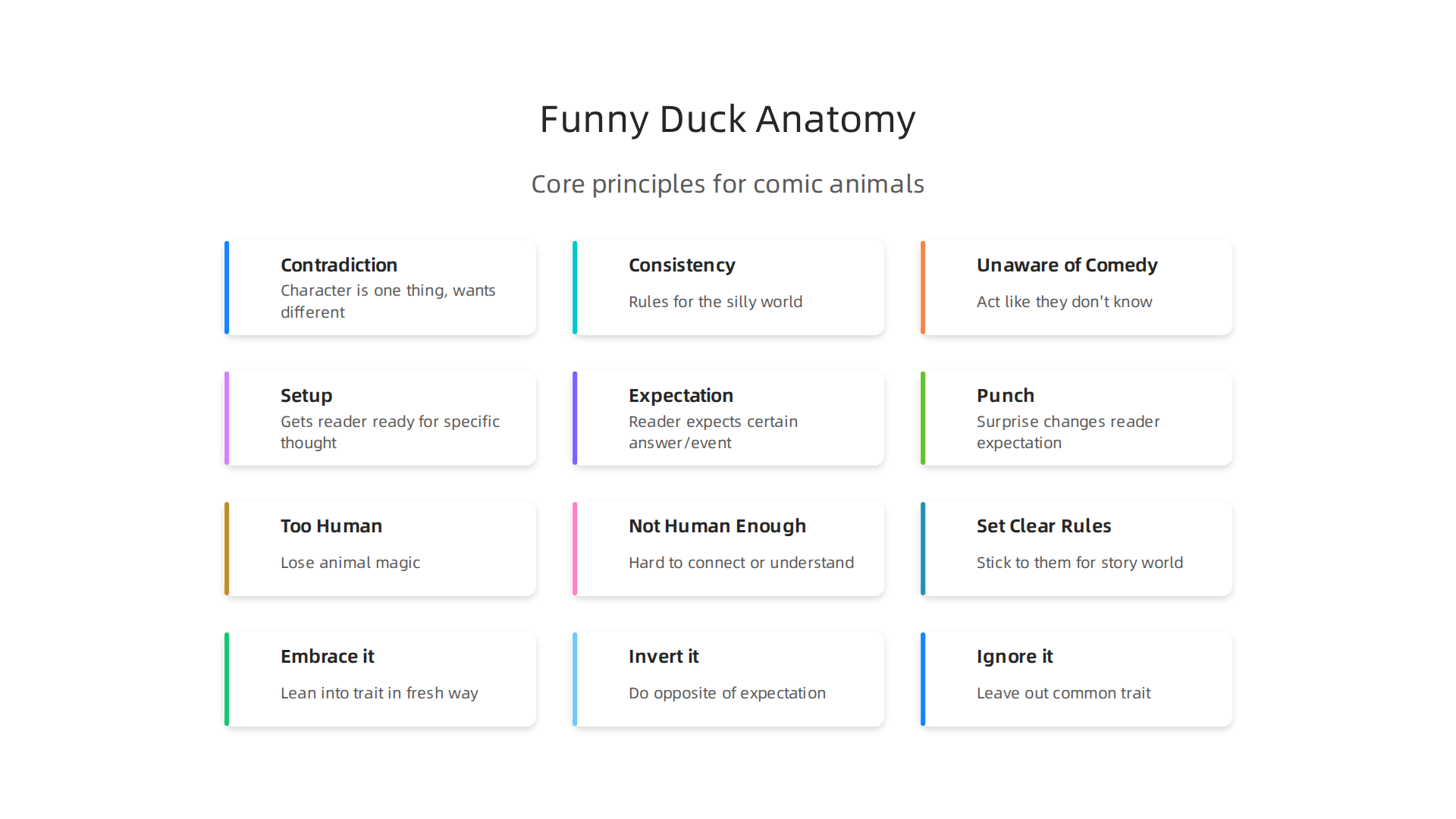
For a [funny duck], the humor comes from the gap between what a duck usually is and what this duck wants to be or do. Imagine a duck who dreams of being an opera singer, or a detective who can’t swim. The fun is in the contrast. When a character sees themselves one way, but we see them as something else, that’s where the laughs happen. Comedy often lives in this space between what a character thinks about themselves and how others see them Tips on writing comedy for writers who don’t write comedy.

A duck trying to manage a big business meeting is funny because ducks don’t do that. Its small wings, quacking, and love for water clash with the serious world of business. This kind of setup makes the comedy clear right away.
It’s also super important to give your [funny duck] consistent rules. Even in a silly world, things need to make sense. If your duck can fly one minute and then can’t the next, it gets confusing. The jokes land better when we understand what the duck can and cannot do. For example, if your duck always tries to use a tiny briefcase but never quite manages to hold it right, that’s consistently funny. But if it suddenly drives a car without any explanation, the humor might fall flat because it breaks the world you’ve set up. Funny characters, even animal ones, work best when they act like they don’t know they are in a comedy. They are just trying to live their lives within the rules of their world Comedy Writing Techniques Explained. This helps readers believe in the story, even when it’s totally goofy.
Thinking about these tips can help you create amazing and laugh-out-loud animal characters for your own stories. If you enjoy learning about how different animals can be hilarious, you might like to read about Why Funny Mutt Characters Unleash Unforgettable Laughter.
Ready to dive into a world where humor and big ideas mix?
Even without drawing a single picture, the way a character moves and acts can make us laugh. For a [funny duck], this means thinking about its tiny habits and gestures. These small, specific actions can become what we call "running jokes." A running joke is something that happens again and again, and it gets funnier each time because we know it’s coming.
Imagine your [funny duck] always tries to smooth its feathers when it gets nervous, even in a serious situation like giving a speech. Or maybe it always taps its beak on things when it’s thinking deeply, making a little tap-tap-tap sound. These little physical quirks tell us more about the duck’s personality. They make the duck feel more real and more lovable. Giving each character a unique way they act helps them stand out, much like giving them a distinct voice in a story 7 Lessons in Comedy Writing from Animal House.
The fun also comes from showing a contrast. A duck usually waddles and swims, right? So, if your [funny duck] tries to act very proper, maybe by trying to cross its tiny legs while sitting at a table or trying to use its small wings to wave goodbye in a grand way, that’s funny. It’s funny because it’s not what we expect a duck to do. This unexpected behavior makes the character more memorable and the humor clear. It’s all about playing with what we know about ducks and then doing something completely different with your special character.
Understanding how these small details add up can really help you make your characters pop. If you’re curious about all the ways humor works, you might enjoy learning Why We Find Things Funny.
Ready to dive into a world where humor, identity, and cosmic chaos collide? Make Your Next Novel Ridiculous.
Speech patterns, idioms, and comedic voice for a duck
Beyond how a funny duck acts, how it speaks also makes us laugh. Think about the sound of its voice and the words it uses. Does your funny duck talk exactly like a person, using big, fancy words? Or does it mix in little quacks and squawks, like, "I’d love to join, quack, if you don’t mind!"
You can choose how "duck-like" its voice is. Maybe it uses human words but gets them a little wrong sometimes, which is called a malapropism. For example, instead of saying, "It’s a piece of cake," it might say, "It’s a piece of quack." These small mistakes can be very funny. Or maybe your funny duck has its own special sayings, or "idioms," that only other ducks would understand. This gives your character a truly unique comedic voice.
The timing of jokes is also super important. A funny duck’s humor can come from quick comebacks, or maybe it always interrupts others at the wrong moment. This is a common comedy writing technique. For example, if someone is giving a serious speech, and your funny duck suddenly says, "Did anyone bring snacks?" it breaks the tension and makes us chuckle. Sometimes, saying something grand and then quickly undercutting it with a silly remark works well. It’s like building up a big idea just to pop it with a tiny pin. To really nail down comedic timing and voice, learning various Comedy Writing Techniques Explained can be very helpful.
Building a funny character involves many layers, from how they look to how they speak. If you enjoy creating unique and hilarious characters, you might find inspiration by exploring other Funny Monkey Characters That Keep Us Laughing For Generations. These careful choices about speech patterns and timing help make your funny duck unforgettable. If you’re ready to explore new worlds of humor, why not Try Funny Fiction With Scope? It’s a sci-fi comedy adventure built for witty, curious readers.
Voice, timing, and comedic beats: making jokes read like laughs
It’s not just what your funny duck says, but how you write it on the page. Good comedy writing uses special tricks to make jokes land well, just like a stand-up comedian uses their voice and body.

You can make your words "sound" funny even when someone is just reading them.
First, let’s look at how a joke works. Most jokes have three main parts:
- The Setup: This is the beginning of the joke. It gets the reader ready and makes them think something specific.
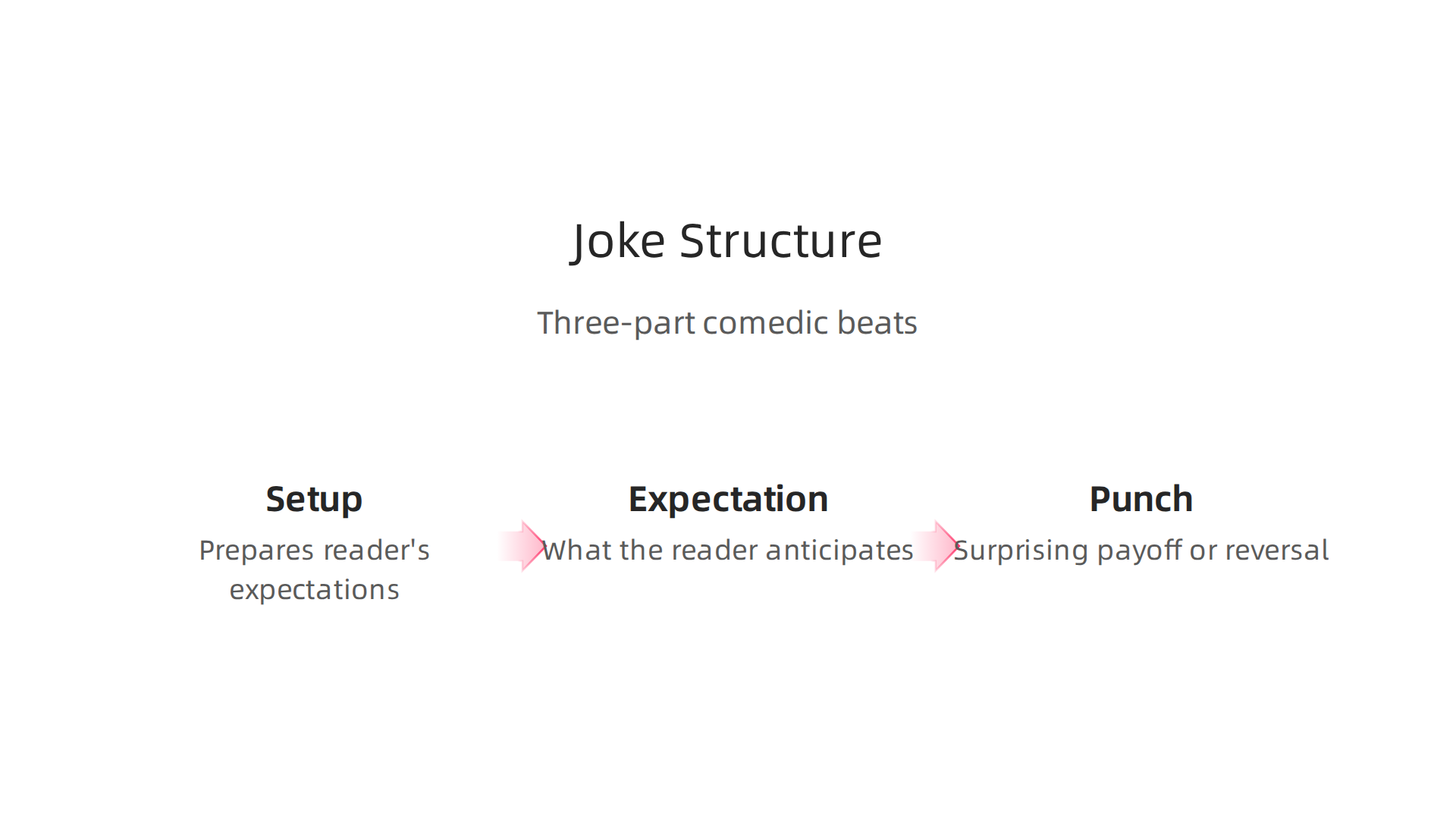
- The Expectation: After the setup, the reader usually expects a certain kind of answer or event to happen next.
- The Punch: This is the funny part! It’s a surprise that changes what the reader expected. It makes them laugh because it’s clever or silly.
You can use this idea for a whole scene, not just one line. For example, if your funny duck is trying to be very serious, that’s the setup. We expect it to be a grown-up, important moment. But then, the punch might be the duck accidentally flapping into a pond, making us chuckle at its failed seriousness. This helps create a truly funny character. You can learn more about how to structure jokes like a pro by looking into Jerry Seinfeld’s 5-Step Comedy Writing Process.
How you write your sentences also helps with timing. Short sentences can make a joke feel quick and snappy, like a sudden surprise. Longer sentences can build up suspense, making the reader wait for the funny part. Think about how you use periods, commas, and even new paragraphs. A short, punchy sentence by itself can act like a big, funny moment on the page. Just like a good speaker knows when to pause for laughter, you can use these writing tools to make your jokes land perfectly.
For example, imagine your funny duck is in a very fancy restaurant.
- Setup (long sentence): "The head chef, a stern-faced man with a tall white hat, brought out the special dish, explaining its rare ingredients in a hushed, respectful voice."
- Punch (short sentence on new line): "And then the funny duck asked for ketchup."
That quick change in tone and sentence length makes the joke much funnier. Understanding Why We Find Things Funny: The Art and Psychology Behind Every Joke can make your writing even stronger.
If you enjoy creating unique and hilarious characters like a funny duck, and want to dive into stories where humor, identity, and cosmic chaos collide, you might want to consider the Ridiculous series.
Make Your Next Novel Ridiculous
Using animal-specific behaviors for jokes and gags (beyond slapstick)
Moving from joke structure, let’s think about how the unique traits of animals can make stories even funnier. It’s not just about a funny duck slipping on a banana peel. We can find humor in what animals naturally do. Think about their instincts and habits, like migrating, mating rituals, or building nests. When a character does these things in a silly or unexpected way, it creates great comedy.
For example, imagine a funny duck who needs to fly south for the winter. That’s a natural behavior. But what if this particular funny duck keeps getting lost because it’s too busy stopping to photograph interesting clouds? Or maybe it tries to convince a westie dog to join its flock, even though westie dogs don’t fly south! These situations come from twisting what we expect an animal to do.
You can take common animal instincts and turn them upside down for laughs.
- A graceful saluki dog known for its speed might try to win a baking contest instead of a race.
- A loyal beauceron dog, usually a protector, could be terribly afraid of shadows.
- A canaan dog, famous for being smart and watchful, might spend all its time trying to solve a puzzle meant for a toddler.
These ideas work well because they play on what we already know about these animals. When their actions go against their nature, it’s a surprising punchline for readers. It makes characters memorable and the story more engaging. Writers often use funny animal tropes to build these kinds of characters and situations. You can explore many ideas about this by looking at Funny Animal Tropes.
The key is to use these natural behaviors or instincts as a starting point. Then, you can make them go wrong, be really dramatic, or just be plain silly. This helps drive the story and gives your animal characters funny reasons for what they do. If you’re looking to create your own hilarious dog characters, understanding Dog Breeds for Humorous Fiction How Each Breed Creates Laughs can give you great ideas.
This kind of comedy, where animal characters behave in unexpected or absurd ways, can make your stories truly shine. It gives them depth beyond simple slapstick. If you enjoy creating unique characters like a funny duck or other animals who find themselves in hilarious, absurd situations, you might be interested in stories that blend humor, identity, and wild scenarios. Looking for Humorous Fiction?
Anthropomorphism vs. animal logic: where to draw the line
When we make animal characters funny by giving them human-like behaviors, we step into the world of anthropomorphism. This big word just means giving human feelings, thoughts, and actions to animals or things. We saw how a funny duck might get lost taking pictures instead of migrating. That’s a bit human, isn’t it? But there’s a trick to it. You need to find a good balance.
If your characters are too human, like a saluki dog that acts exactly like a person, they might not seem special anymore. The fun part of an animal character is seeing their animal nature mix with human traits.
If there’s too much human, they lose that animal magic. On the other hand, if your animal characters are not human enough, it can be hard for readers to feel for them or understand their jokes. People tend to connect more with things that show human qualities, as this process helps us understand how to relate to them, even if they’re not actually human. Research shows that this process of how people understand and treat nonhuman agents is a key part of how we interact with them.
The best way is to set some clear rules for your animal world early on. Decide how much your characters can think, talk, and act like people. For example, can your funny duck talk out loud, or does it just think human thoughts? Does a beauceron dog solve problems like a person, or does it still use its dog instincts? Maybe a westie dog can read, but a canaan dog only understands simple words.
Whatever rules you pick, stick to them. This helps readers know what to expect and keeps your story’s world strong and believable, even when it’s silly. When your animal characters are both funny and easy to connect with, they really shine. You can learn more about creating memorable characters in stories with funny fictional dogs.
Ready to dive into stories where characters, human or otherwise, find themselves in hilarious and often absurd situations?
Try Funny Fiction With Scope
The rules you set for how human your animal characters are will help a lot. But even with good rules, it’s easy to fall into old patterns. That’s why we need to talk about avoiding clichés. A cliché is an idea or a story detail that has been used so many times it’s not fresh or interesting anymore. When you’re making a funny duck or any other animal character, you want them to feel special, not like every other animal in a story.
To make your creatures feel original, first, you need to spot these common animal story ideas, also called "tropes." For example, maybe you think all saluki dogs are graceful and quiet. Or perhaps every beauceron dog is a serious guard. What about a westie dog being always cheerful, or a canaan dog being super smart? These are common ideas. Some of these common ideas are listed as Funny Animal Tropes which you can look at. Once you know these common ideas, you can choose what to do with them.
You have three choices for a trope:
- Embrace it: Sometimes, leaning into a well-known trait can be funny if you do it in a fresh way.
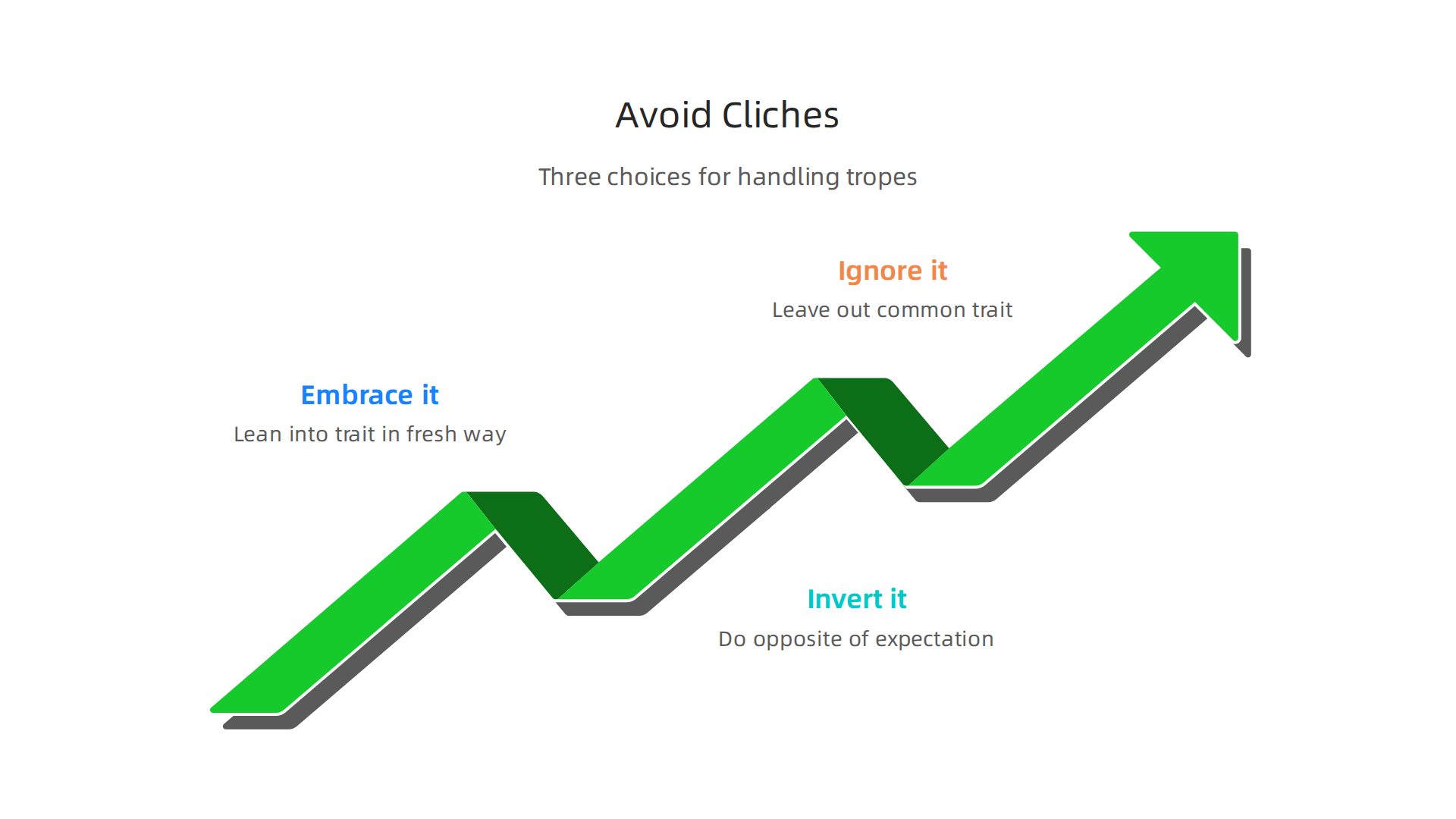
A funny duck who is extraordinarily obsessed with bread, for instance, might be amusing because it’s such a duck-like thing to do, but dialed up to eleven.
- Invert it: This means doing the opposite of what people expect. Imagine a graceful saluki dog who is actually super clumsy. Or a serious beauceron dog who is terrified of squirrels. A westie dog known for its boundless energy could be the laziest character. A normally smart canaan dog might be charmingly air-headed.
- Ignore it: You can simply choose to leave out the common trait altogether and focus on entirely new things that make your character unique.
The trick is to add specific and surprising details. Don’t just make a dog character "brave." Make them "brave, but only when protecting their favorite squeaky toy from imaginary threats." This adds a fun twist that turns a simple trait into a comedic gem. Thinking about the actual breed traits and then twisting them can create really unique and hilarious characters. You can get more ideas on how different animal types add to humor in stories by looking at Dog Breeds for Humorous Fiction.
Ready to dive into stories where characters, human or otherwise, find themselves in hilarious and often absurd situations? Start the series where humor, identity, and cosmic chaos collide.
Make Your Next Novel Ridiculous
Creating funny animal characters is great, but it’s also important to make sure your jokes land well and don’t accidentally upset anyone. Just like you think about how a saluki dog might act, you also need to think about how your character might be seen by different people.
Testing jokes, sensitivity checks, and cultural considerations
When you give human qualities to animals, like making a funny duck talk or a beauceron dog solve puzzles, you’re making them "anthropomorphic." This means giving them human traits, feelings, or actions. People do this a lot with animals, and it helps them understand these characters better, as research on The Development of Anthropomorphism in Interaction shows.
Because your animal characters act like people, they might accidentally remind readers of different groups or cultures. To avoid any problems, you should do what are called "sensitivity checks." This means having different people read your story, especially those from various backgrounds, to see how they feel about it.

For example, if your story features a character like a canaan dog with a certain personality, someone might connect that personality to a human group. You want to make sure you are showing cultural sensitivity regarding cultural representation, especially in creative works, as highlighted in the Exhibitor Guide for 2026 from OSU Extension Service. Thinking about intercultural communication can really help here, as discussed in the Intercultural Reflection Tool guide.
It’s also a good idea to "A/B test" your jokes. This means trying out different versions of a joke or a funny scene to see which one gets the most laughs. You can do this in writing workshops or with a small group of early readers. If a joke about a clumsy westie dog falls flat for some, you might need to change it. This way, you make sure your humor is strong and fun for everyone.
Looking for Humorous Fiction? The Ridiculous brings absurd comedy into a full sci-fi story world. Looking for Humorous Fiction?
Summary
This article explains why animal characters are uniquely effective for comedy and gives practical guidance for creating them without falling into clichés. It shows how surprise and anthropomorphism—putting human traits onto animals—generate quick laughs, and why animals provide useful narrative distance for satire. You’ll learn how to design a comic protagonist (using contradiction, consistent rules, and running gags), craft distinctive speech and timing, and use animal-specific instincts for original jokes. The piece also covers how much humanity to give an animal, how to avoid overused tropes, and simple sensitivity checks and A/B testing methods to keep humor fresh and fair. After reading, you’ll be able to plan, write, and test funny animal characters that land reliably and feel memorable.